
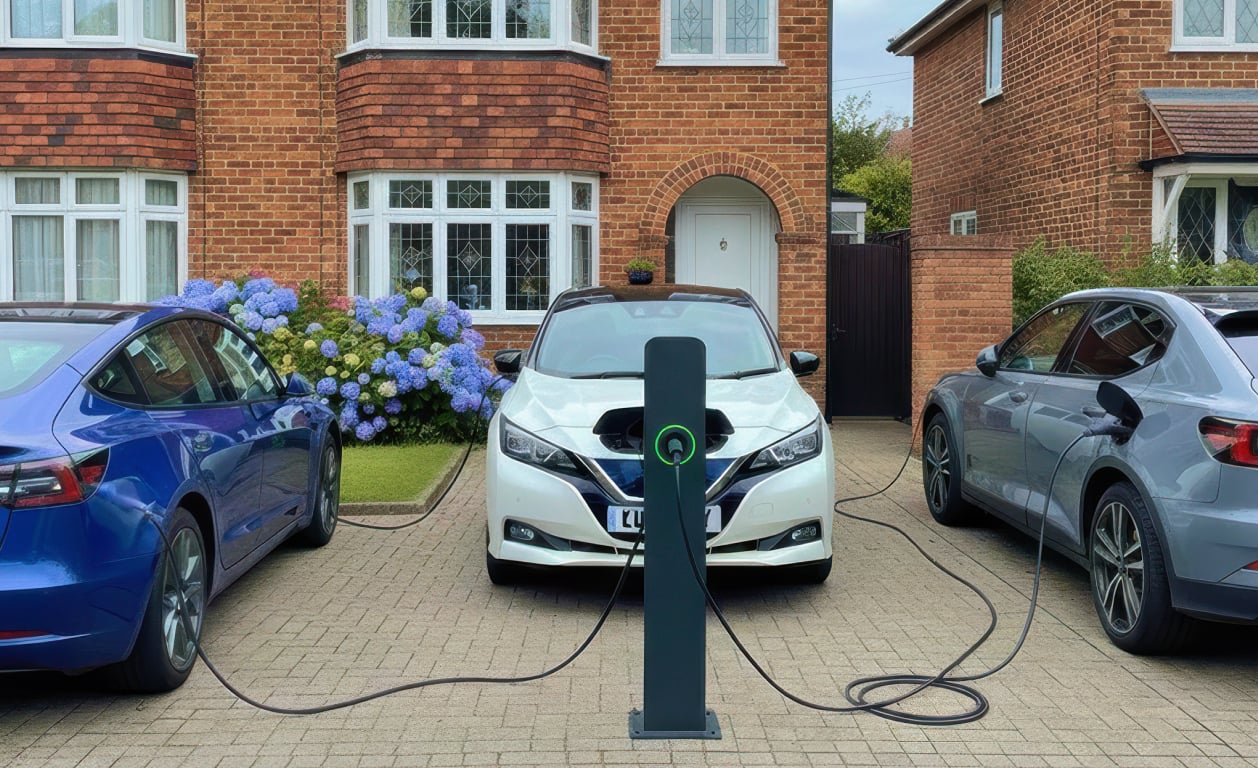
As fleet electrification accelerates, a new logistical challenge is emerging for fleet managers: the multi-EV household.
Your drivers may already own a personal electric vehicle, or perhaps two company drivers reside at the same address. When assigning a new fleet asset to these locations, the standard "one charger per driver" policy often hits a wall.
How do you manage hardware installation when a charger already exists? How do you ensure the domestic supply can handle the load? And crucially, how do you separate the charging data for accurate reimbursement?
This article explores the operational and technical considerations for charging two electric vehicles at a single domestic property.
Scenario 1: Utilising existing infrastructure (One charger, two vehicles)
The most capital-efficient option is to utilise a single charge point for multiple vehicles. This avoids the CapEx of a secondary installation. However, for fleet operations, this introduces two specific challenges: operational readinessand reimbursement accuracy.
Reliability is key. Relying on a driver to manually swap cables between a personal car and a fleet van requires discipline. If the fleet vehicle is not plugged in overnight, it may not have sufficient range for the next day's duty cycle.
If a driver uses one charger for both business and personal mileage, accurate reimbursement becomes difficult without the right software. Fleet managers must ensure that the charge point software, or a third-party solution like Rightcharge, can distinguish between the fleet vehicle's energy consumption and personal usage to prevent overpayment on expenses.
Scenario 2: Installing a secondary charge point
For high-mileage drivers or households where vehicle uptime is critical, installing a second distinct unit is often the preferred operational choice.
The primary constraint here is the domestic main fuse (typically 60A, 80A, or 100A). Two standard 7kW chargers running simultaneously can draw roughly 64A, which risks tripping the main house fuse if other appliances are running. To mitigate this without expensive grid upgrades, you must specify chargers with Dynamic Load Management (DLM). These units communicate with each other (or a central hub) to cap the total power draw. If both cars are plugged in, they split the available current (e.g., 3.5kW each). When one car finishes, the other automatically ramps up to full speed (7kW).
Upgrading a driver’s domestic supply to three-phase is rarely a viable ROI, often costing thousands of pounds. Intelligent load balancing is the standard industry solution to avoid this cost.
Scenario 3: Installing a dual-socket charger
A dual-socket charger (a single unit with two outlets) offers a streamlined solution for multi-EV driveways.
From a procurement perspective, a dual unit is often more cost-effective than two separate smart chargers. It requires only one mounting point and one run of cabling back to the consumer unit, reducing installation labour and disruption at the employee's home.
Like separate units, dual chargers typically feature built-in load balancing. They will automatically distribute the available power between the two sockets. Fleet managers should ensure the chosen hardware supports split billing or RFID tagging so that charging sessions can be assigned to specific vehicles (e.g., "Company Van" vs. "Spouse's Car").
Scenario 4: The 3-pin plug (Emergency use only)
Technically, a driver could charge the fleet vehicle on a dedicated wallbox and a second vehicle on a standard domestic 3-pin socket ("Granny Cable").
For fleet application, this should be viewed as a temporary or emergency measure only. 3-pin charging is slow (roughly 2.3kW), unmanaged, and lacks the data connectivity required for automated reimbursement. Continuous heavy load on domestic wiring sockets can pose safety risks if the wiring is old or uninspected. Most robust fleet policies advise against relying on 3-pin charging for daily duty cycles.
Scenario 5: Hybrid charging (Home + public network)
If home power capacity is strictly limited, a hybrid strategy may be required. The driver charges the primary fleet vehicle at home overnight to secure the low-cost "base load," while the second vehicle utilises the public charging network. While this solves the hardware constraint, it significantly increases Operational Expenditure (OpEx). Public charging costs are typically 3-4 times higher than domestic rates.
Reducing TCO: The role of energy tariffs
Regardless of the hardware configuration, the "fuel" cost is determined by the driver’s energy tariff. When two EVs are charging at one location, energy consumption doubles. It is imperative to encourage or facilitate drivers to switch to an EV-friendly energy tariff. These tariffs offer low-rate windows (often overnight) costing as little as 7p-9p per kWh. Aligning the fleet charging schedule with these off-peak hours can reduce the "fuel" cost per mile by up to 70% compared to standard variable rates.
Summary for fleet leaders
Managing multi-EV households is a growing component of fleet strategy.
- Audit the home: Before delivering a vehicle, determine if a charger already exists.
- Protect the supply: Always specify hardware with Dynamic Load Management (CT clamps) to protect the employee's home fuse.
- Solve the data: Use software that separates business kWh from personal kWh to ensure HMRC compliance and fair reimbursement.