
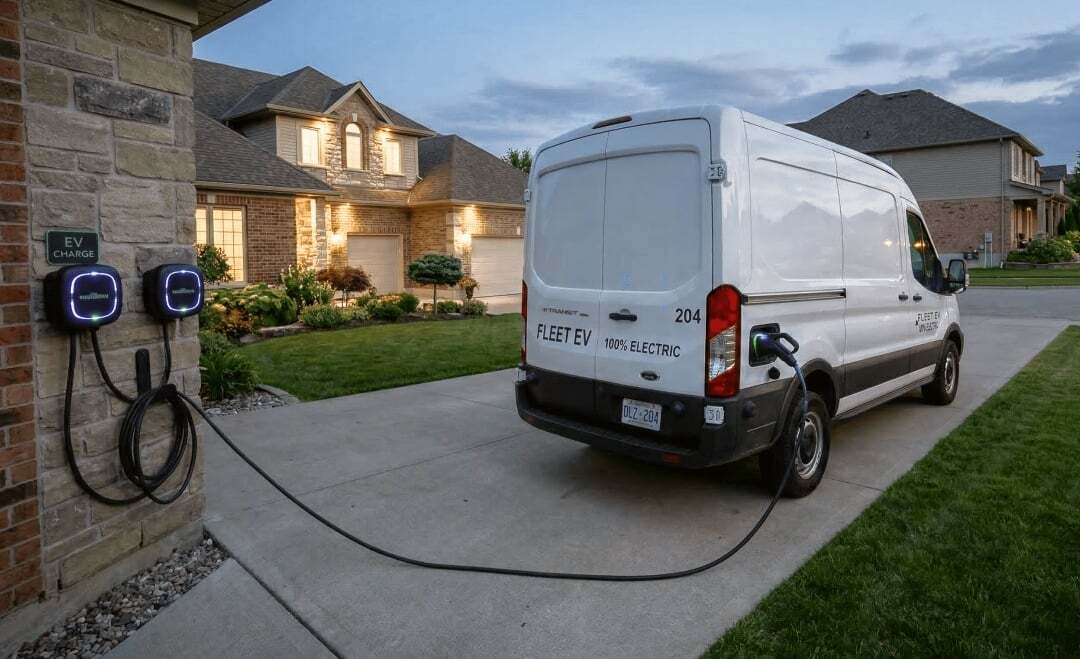
Home is often the cheapest and most convenient way to charge fleet vehicles for employees with a driveway.
Home charging costs around 25p/kWh while the public network sit at around 81p/kWh. That’s more than three times the price. When The AA moved to Rightcharge, they shifted 82% of their home charging to home and saved up to £1,000 per driver, per year.
Most drivers start and end their day at home. A home charger means a full battery every morning.
But installing the charger at a driver's home can raise questions for fleets. Who pays for the charger? Who owns it? What happens if the driver leaves the company or moves house?
There are three ways to handle it: if a fleet decides to pay upfront for the home charger, policy, charger choice or splitting the cost with drivers if they’re looking to use it for their personal EV. Fleets can also go halves on the installation cost, a fair split if drivers plan to use the charger for personal charging too.
Put a clawback policy in place
A home charger installation typically costs around £1,000. For a fleet rolling out multiple chargers, that cost can add up and the question around some of the drivers leaving within a year or two is a fair one.
One solution is a clawback clause in the driver’s employment contract or fleet agreement.
The clause sets out who owns the hardware and whether the driver contributes to the installation cost if they leave within a certain time period of having the charger installed. A typical approach is pro-rata repayments over a couple of years. So if a driver leaves within a couple of years, they pay back a proportion of the charger installation cost.
Leaving a charger in place with a simple clawback clause can be a simple solution.
Choose a charger that’s designed to move
The other approach is to choose a charger that’s easily removable.
The Eassee one is a very popular charger in the UK and has a practical backplate system, making it easy to remove.
The wiring is fixed to a wall-mounted backplate when it’s installed. The charger unit clips on and off without any electrical work.
When a driver leaves the company or moves house, the charger can be simply removed and rewired elsewhere.
Then there’s home charging reimbursement
Once chargers are in place, the next question is how to pay drivers back for the electricity they use to charge their work vehicles.
Rightcharge is an EV fleet charging payment platform that handles everything from plug-in to pay-out. Drivers get automated reimbursements to their energy accounts; fleets get one bill for all their drivers' charging.
Find out more about Rightcharge’s EV payment platform: https://rightcharge.com/product